什么是物质?
我们身边几乎所有东西都是由物质组成的。无论是会生长的生物,还是桌椅、石头这些非生物,都是物质。物质有两个共同点:它有质量,也会占据空间。物质有三种形态:固体、液体和气体。
jirim = 物质
Hampir semua benda di sekeliling kita terdiri daripada jirim. Benda hidup seperti pokok dan benda bukan hidup seperti meja kedua-duanya ialah jirim. Setiap jirim mempunyai jisim dan menempati ruang. Jirim wujud dalam tiga keadaan, iaitu pepejal, cecair dan gas.
Contoh: Seekor kucing, sebiji bola dan udara di dalam bilik darjah semuanya ialah jirim kerana ada jisim dan memerlukan ruang.
Awas: Jangan anggap hanya benda yang boleh dipegang sahaja ialah jirim.
matter = 物质
Almost everything around us is made of matter. Living things such as trees and non-living things such as tables are both matter. Every kind of matter has mass and takes up space. Matter exists in three states: solid, liquid and gas.
Example: A cat, a ball and the air inside the classroom are all matter because each has mass and needs space.
Watch out: Do not think that only things you can hold are matter.
物质形态分一分
把物品依形态分类:书包、铁钉、木尺是固体;椰子水、酱油、食用油是液体;氧气、二氧化碳、水蒸气是气体。要注意,彩虹不是物质,它是光经过折射和反射形成的自然现象,不属于任何一种形态。
pengelasan jirim = 物质分类
Kita boleh mengelaskan bahan mengikut keadaannya. Beg sekolah dan paku ialah pepejal, air kelapa dan kicap ialah cecair, manakala oksigen dan karbon dioksida ialah gas. Pelangi pula bukan jirim kerana ia terbentuk daripada pembiasan dan pantulan cahaya.
Contoh: Selepas hujan, pelangi kelihatan di langit tetapi ia tidak boleh dimasukkan ke dalam mana-mana kumpulan keadaan jirim.
classifying matter = 物质分类
We can group materials by their state. A school bag and a nail are solids, coconut water and soy sauce are liquids, while oxygen and carbon dioxide are gases. A rainbow, however, is not matter because it forms from the refraction and reflection of light.
Example: After rain a rainbow appears in the sky, yet it cannot be placed in any state-of-matter group.
以下哪一组物品全部都是液体?
cecair = 液体
Periksa setiap benda dalam satu kumpulan dengan teliti. Satu kumpulan yang betul mesti mengandungi bahan yang semuanya boleh mengalir dan mengikut bentuk bekas. Jika ada satu benda keras atau satu gas, kumpulan itu tidak sesuai.
Contoh: Sirap yang dituang ke dalam gelas mengikut bentuk gelas itu.
Awas: Ingat bahawa pelangi bukan jirim.
liquid = 液体
Check every item in a group carefully. A correct group must contain materials that can all flow and take the shape of their container. If even one item is hard or is a gas, that group does not fit.
Example: Syrup poured into a glass takes the shape of the glass.
Watch out: Remember that a rainbow is not matter.
物质有固定的形状吗?
把一颗石头放进夹链袋里摇一摇、压一压,石头的形状不变;把颜色水放进袋子,袋子被压时,水的形状跟着改变;用手压充了气的气球,气球很容易变形。可见固体有固定的形状,液体和气体没有。
bentuk tetap = 固定的形状
Ujian ini membandingkan sama ada sesuatu bahan mengekalkan bentuknya. Batu di dalam beg zip tidak berubah bentuk walaupun beg itu digoncang atau ditekan. Air berwarna dan udara di dalam belon pula berubah bentuk apabila bekasnya ditekan.
Contoh: Air kelapa mengikut bentuk mangkuk bulat atau kotak segi empat, tetapi sekeping biskut tetap sama bentuknya.
fixed shape = 固定的形状
This test compares whether a material keeps its own shape. A stone in a zip bag does not change shape even when the bag is shaken or pressed. Coloured water and the air in a balloon change shape when their container is squeezed.
Example: Coconut water follows the shape of a round bowl or a square box, but a biscuit keeps the same shape.
物质有质量吗?
把两个纸杯挂在衣架两边,让衣架平衡。在一边放进石头或倒进颜色水,衣架就向那一边倾斜,说明固体和液体有质量。把两个一样大的充气气球挂在两边,刺穿其中一个让空气跑掉,衣架会向还有空气的气球倾斜,说明气体也有质量。
jisim = 质量
Penyangkut baju boleh dijadikan neraca ringkas. Apabila batu atau air berwarna dimasukkan ke dalam cawan pada satu sisi, penyangkut condong ke sisi itu. Apabila satu belon dipecahkan, penyangkut condong ke arah belon yang masih berisi udara, jadi gas juga mempunyai jisim.
Contoh: Bacaan penimbang elektronik bertambah apabila botol kosong diisi dengan air.
Awas: Pita pelekat pada belon membantu belon pecah perlahan supaya ujian lebih adil.
mass = 质量
A clothes hanger can act as a simple balance. When a stone or coloured water is put into the cup on one side, the hanger tilts towards that side. When one balloon is popped, the hanger tilts towards the balloon that still holds air, so gas has mass too.
Example: The reading on a digital scale goes up when an empty bottle is filled with water.
Watch out: Tape on the balloon helps it deflate slowly so the test is fairer.
物质有固定的体积吗?
体积是物体所占据空间的大小。石头放进 50 mℓ 或 60 mℓ 水的量筒,水位上升的量都一样,所以固体的体积固定。100 mℓ 颜色水从一个量筒倒进另一个量筒,仍是 100 mℓ,液体体积也固定。注射器里的空气被堵住后按下活塞,体积变小,气体的体积不固定。
isi padu = 体积
Isi padu ialah ruang yang diduduki oleh sesuatu objek. Batu yang dimasukkan ke dalam silinder penyukat menaikkan aras air dengan jumlah yang sama setiap kali. Air berwarna yang dituang dari satu silinder ke silinder lain kekal 100 mililiter, tetapi udara dalam picagari boleh dimampatkan.
Contoh: Udara dalam picagari berkurang daripada dua puluh kepada dua belas mililiter apabila omboh ditekan.
volume = 体积
Volume is the amount of space an object occupies. A stone placed in a measuring cylinder raises the water level by the same amount each time. Coloured water poured from one cylinder into another stays at 100 millilitres, but the air in a syringe can be compressed.
Example: The air in a syringe shrinks from twenty to twelve millilitres when the plunger is pushed.
物质会占据空间吗?
把石头放进装满水的杯子,水溢出来;把颜色水倒进装满水的杯子,水也溢出来。这表示固体和液体都占据了原本水所在的空间。把空杯子倒扣压进颜色水里,水进不了杯子,因为杯里的空气占据了空间。
menempati ruang = 占据空间
Air melimpah keluar apabila batu atau air berwarna dimasukkan ke dalam cawan yang penuh. Ini membuktikan pepejal dan cecair menempati ruang. Apabila cawan kosong diterbalikkan ke dalam air, air tidak dapat masuk kerana udara di dalam cawan sudah memenuhi ruang itu.
Contoh: Tisu di dasar cawan yang diterbalikkan ke dalam baldi air tetap kering.
Awas: Pastikan cawan benar-benar penuh dan piring kosong sebelum ujian.
takes up space = 占据空间
Water spills over when a stone or coloured water is added to a full cup. This proves that solids and liquids take up space. When an empty cup is turned upside down and pushed into water, the water cannot enter because the air inside already fills that space.
Example: A tissue at the bottom of an upturned cup pushed into a bucket of water stays dry.
Watch out: Make sure the cup is really full and the dish empty before testing.
把空杯子倒扣,垂直压进水盆里,水进不了杯子。这说明了什么?
udara menempati ruang = 空气占据空间
Fikirkan apa yang berada di dalam cawan sebelum ditekan ke dalam air. Cawan itu kelihatan kosong tetapi sebenarnya dipenuhi sesuatu yang tidak dapat dilihat. Tanya diri sendiri mengapa air tidak dapat masuk ke tempat itu.
Contoh: Sebuah botol kosong yang ditekan ke dalam kolam terasa ditolak ke atas.
air occupies space = 空气占据空间
Think about what is inside the cup before it is pushed into the water. The cup looks empty but is actually filled with something invisible. Ask yourself why the water cannot move into that place.
Example: An empty bottle pushed into a pool feels as if it is being pushed back up.
固体、液体和气体的性质
三种形态的共同点:都有质量,也都会占据空间。不同点:固体有固定的形状和体积;液体会流动,没有固定的形状,但有固定的体积;气体没有固定的形状,也没有固定的体积。气体的粒子之间距离很大,所以能被压缩。
sifat pepejal, cecair dan gas = 三态性质
Ketiga-tiga keadaan jirim mempunyai jisim dan menempati ruang. Pepejal mempunyai bentuk dan isi padu tetap. Cecair boleh mengalir dan mempunyai isi padu tetap tetapi tiada bentuk tetap. Gas tiada bentuk tetap dan tiada isi padu tetap kerana zarahnya berjauhan dan boleh dimampatkan.
Contoh: Kulit bola keranjang ialah pepejal manakala udara di dalamnya ialah gas yang dimampatkan.
properties of the three states = 三态性质
All three states of matter have mass and take up space. A solid has a fixed shape and a fixed volume. A liquid can flow and has a fixed volume but no fixed shape. A gas has neither a fixed shape nor a fixed volume because its particles are far apart and can be squeezed closer.
Example: The skin of a basketball is a solid while the air pumped inside is a compressed gas.
物质由粒子组成
所有物质都是由粒子组成的,不同形态的物质,粒子的排列方式也不同。固体中的粒子紧密地排列在一起,只会在固定的位置上振动,好像早会时排好队、站在原位不动的学生。
zarah = 粒子
Semua jirim terdiri daripada zarah-zarah yang sangat kecil. Dalam pepejal, zarah tersusun rapat antara satu sama lain dan hanya bergetar pada kedudukan yang tetap. Susunan ini menyebabkan pepejal mengekalkan bentuknya.
Contoh: Murid yang berbaris semasa perhimpunan dan hanya bergoyang di tempat masing-masing menyerupai zarah pepejal.
particles = 粒子
All matter is made up of very tiny particles. In a solid, the particles are packed closely together and only vibrate in fixed positions. This arrangement lets a solid keep its own shape.
Example: Pupils lined up at assembly who only sway on the spot are like the particles of a solid.
液体和气体中的粒子
液体中的粒子之间有距离,可以振动,也可以短距离移动,就像在食堂里四处走动的学生,所以液体会流动。气体中的粒子之间有很大的距离,振动和移动得很快,就像在球场上踢球、到处奔跑的学生。
susunan zarah cecair dan gas = 液气粒子排列
Zarah cecair mempunyai ruang di antaranya, jadi zarah boleh bergetar dan bergerak dalam jarak yang pendek. Zarah gas pula berjauhan antara satu sama lain dan bergerak dengan sangat laju ke semua arah. Perbezaan inilah yang menjadikan cecair boleh mengalir dan gas memenuhi seluruh bekas.
Contoh: Dalam aktiviti simulasi, kumpulan dalam petak terbesar berlari bebas seperti zarah gas.
particles in liquids and gases = 液气粒子排列
Liquid particles have spaces between them, so they can vibrate and move over short distances. Gas particles are far apart from one another and move very quickly in all directions. This difference explains why liquids can flow and gases fill the whole container.
Example: In the simulation game, the group in the largest box runs around freely like gas particles.
哪一项正确描述了液体中的粒子?
zarah cecair = 液体粒子
Bandingkan setiap pilihan dengan tiga keadaan jirim yang telah dipelajari. Satu pilihan menggambarkan pepejal dan satu lagi menggambarkan gas. Ingat juga bahawa zarah dalam semua keadaan sentiasa bergetar, jadi pilihan yang menyatakan zarah langsung tidak bergerak adalah salah.
Contoh: Murid yang berjalan perlahan di kantin masih bergerak tetapi tidak berlari jauh.
liquid particles = 液体粒子
Compare each option with the three states of matter you have learned. One option describes a solid and another describes a gas. Remember too that particles in every state are always vibrating, so an option saying they never move is wrong.
Example: Pupils walking slowly around the canteen are still moving but not running far.
水的三种形态
水是我们最熟悉的物质,它有固体、液体和气体三种形态:冰块是固体,杯里的水是液体,看不见的水蒸气是气体。在自然界,冰、雪和霜是水的固体形态;雨、雾、露和云是水的液体形态。
keadaan air = 水的形态
Air wujud dalam tiga keadaan, iaitu ais sebagai pepejal, air sebagai cecair dan wap air sebagai gas. Dalam alam semula jadi, salji dan fros ialah bentuk pepejal air. Hujan, kabus, embun dan awan pula ialah bentuk cecair kerana terdiri daripada titisan air yang halus.
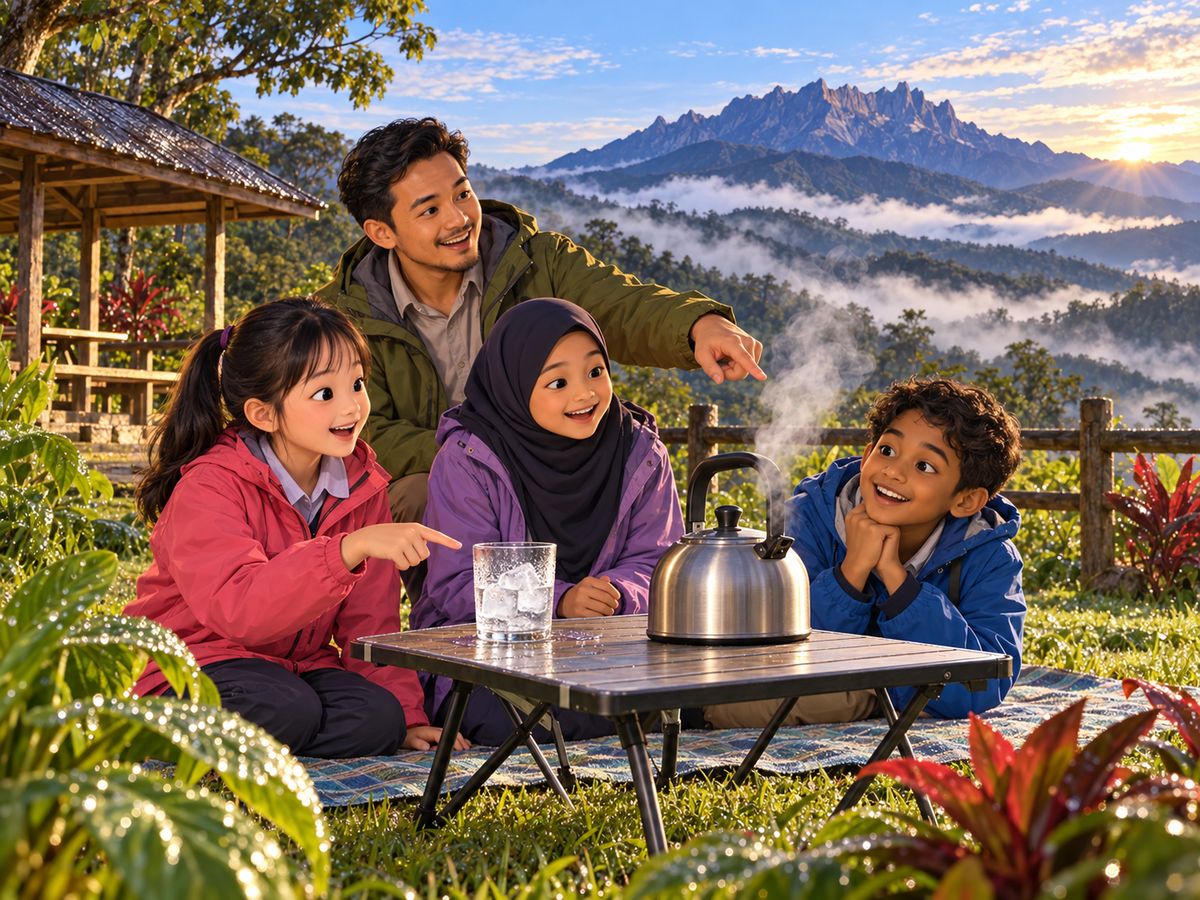
Contoh: Pada waktu pagi di Gunung Kinabalu, fros boleh terbentuk di puncak dan kabus menyelubungi lereng.
Awas: Wap air tidak kelihatan; awan putih ialah titisan air yang kecil.
states of water = 水的形态
Water exists in three states: ice as a solid, water as a liquid and water vapour as a gas. In nature, snow and frost are solid forms of water. Rain, fog, dew and clouds are liquid forms because they are made of tiny drops of water.
Example: On a cold morning at Mount Kinabalu, frost may form at the summit while fog covers the slopes.
Watch out: Water vapour is invisible; a white cloud is made of tiny water drops.
以下哪一项是水的固体形态?
pepejal air = 水的固体形态
Fikirkan sama ada setiap pilihan terdiri daripada kristal ais atau titisan air. Embun, kabus dan awan dibentuk oleh titisan yang sangat halus. Hanya satu pilihan terbentuk apabila wap air menjadi kristal ais pada permukaan yang sangat sejuk.
Contoh: Lapisan putih nipis pada rumput pada pagi yang sangat sejuk boleh menjadi petunjuk.
solid form of water = 水的固体形态
Think about whether each option is made of ice crystals or water drops. Dew, fog and clouds are formed by very tiny drops. Only one option forms when water vapour turns into ice crystals on a very cold surface.
Example: A thin white layer on grass on a freezing morning can be a clue.
受热和散热会改变形态
水的形态会在受热或散热后改变。受热时,冰块变成水,水再变成水蒸气;散热时,水蒸气变回水,水再变成冰块。例如冰块在柠檬茶里不见了、湿桌面慢慢变干、水壶里的水滚了、冰冷的水壶外面出现水珠,都是水的形态在改变。
menyerap haba dan membebaskan haba = 受热与散热
Keadaan air boleh berubah apabila air menyerap haba atau membebaskan haba. Apabila menyerap haba, ais menjadi air dan air menjadi wap air. Apabila membebaskan haba, perubahan berlaku ke arah yang bertentangan, iaitu wap air kembali menjadi air dan air menjadi ais.
Contoh: Ais dalam segelas Milo semakin kecil dan permukaan luar gelas menjadi basah.
gaining and losing heat = 受热与散热
The state of water can change when it gains heat or loses heat. When heat is gained, ice turns into water and water turns into water vapour. When heat is lost, the change goes the other way, so water vapour returns to water and water becomes ice.
Example: The ice in a glass of Milo gets smaller and the outside of the glass becomes wet.
融化和凝固
冰块受热时会融化成水:固体变成液体。水散热,温度降到冰点(0 °C)时会凝固成冰块:液体变成固体。把水放进冷冻格几小时后结成冰,是凝固;把冰块放在户外几分钟后变成水,是融化。
peleburan dan pembekuan = 融化与凝固
Peleburan berlaku apabila ais menyerap haba dan bertukar daripada pepejal kepada cecair. Pembekuan pula berlaku apabila air membebaskan haba sehingga mencapai takat beku, lalu bertukar daripada cecair kepada pepejal. Kedua-dua proses ini bertentangan antara satu sama lain.
Contoh: Jus mangga dalam acuan aiskrim batang membeku di dalam peti sejuk beku dan melebur semula di bawah matahari.
Awas: Takat beku air ialah sifar darjah Celsius.
melting and freezing = 融化与凝固
Melting happens when ice gains heat and changes from a solid into a liquid. Freezing happens when water loses heat until it reaches its freezing point and changes from a liquid into a solid. These two processes are opposites of each other.
Example: Mango juice in an ice-lolly mould freezes in the freezer and melts again under the sun.
Watch out: The freezing point of water is zero degrees Celsius.
蒸发和沸腾
水吸收热量后会蒸发成水蒸气;水被加热到沸腾时,也会转化成水蒸气。两者都是液体变成气体、都要受热。蒸发在平常温度就会慢慢发生,只在水面进行;沸腾要把水加热到 100 °C,水里冒出大量气泡,变化很快。
penyejatan dan pendidihan = 蒸发与沸腾
Penyejatan dan pendidihan kedua-duanya menukarkan cecair kepada gas apabila air menyerap haba. Penyejatan berlaku perlahan pada permukaan air pada suhu biasa. Pendidihan berlaku dengan cepat apabila air dipanaskan hingga seratus darjah Celsius dan banyak gelembung terbentuk di dalam air.
Contoh: Aras air dalam bikar di luar kelas menurun selepas dua jam, manakala air dalam periuk di atas dapur menggelegak.
Awas: Penyejatan tidak memerlukan air mendidih.
evaporation and boiling = 蒸发与沸腾
Evaporation and boiling both turn a liquid into a gas when water gains heat. Evaporation happens slowly at the water surface at ordinary temperatures. Boiling happens quickly when water is heated to one hundred degrees Celsius and many bubbles form inside the water.
Example: The water level in a beaker outside the class drops after two hours, while water in a pot on the stove bubbles.
Watch out: Evaporation does not need the water to boil.
凝聚
水蒸气冷却、散热时,会凝聚成水:气体变成液体。在烧杯里倒热水,盖上铁盖子,几分钟后盖子底面有许多小水珠;冰橙汁杯子外壁出现小水珠,也是空气中的水蒸气碰到冰冷的杯子而凝聚的。
kondensasi = 凝聚
Kondensasi berlaku apabila wap air disejukkan dan membebaskan haba lalu bertukar menjadi air. Wap daripada air panas dalam bikar membentuk titisan air pada bahagian bawah penutup besi. Titisan pada dinding luar gelas jus sejuk pula datang daripada wap air di udara sekeliling.
Contoh: Asap putih di sekeliling aiskrim batang yang baru dikeluarkan dari peti sejuk ialah titisan air yang sangat halus.
Awas: Titisan di luar gelas bukan air yang meresap keluar dari dalam gelas.
condensation = 凝聚
Condensation happens when water vapour cools down, loses heat and turns into water. Steam from hot water in a beaker forms droplets on the underside of an iron lid. Droplets on the outside of a cold juice glass come from water vapour in the surrounding air.
Example: The white mist around an ice lolly just taken out of the fridge is made of very tiny water drops.
Watch out: The droplets outside the glass are not juice leaking through the glass.
形态变化时粒子怎样改变?
物质受热时,粒子移动得较快,粒子之间的距离变得较远:固体融化成液体,液体再蒸发或沸腾成气体。物质散热时,粒子移动得较慢,粒子之间的距离变得较近:气体凝聚成液体,液体凝固成固体。粒子本身的大小不会改变。
perubahan susunan zarah = 粒子排列的变化
Apabila jirim menyerap haba, zarahnya bergerak lebih laju dan jarak antara zarah menjadi lebih jauh. Apabila jirim membebaskan haba, zarah bergerak lebih perlahan dan menjadi lebih rapat. Perubahan susunan inilah yang menyebabkan keadaan jirim berubah, walaupun saiz zarah tetap sama.
Contoh: Ketika air dalam periuk mendidih, zarah air bergerak semakin laju sehingga sebahagiannya terlepas sebagai wap.
Awas: Zarah tidak menjadi lebih besar apabila dipanaskan.
change in particle arrangement = 粒子排列的变化
When matter gains heat, its particles move faster and the distance between them becomes greater. When matter loses heat, the particles move more slowly and come closer together. This change in arrangement is what changes the state of matter, even though the particles stay the same size.
Example: As water in a pot boils, its particles move faster and faster until some escape as vapour.
Watch out: Particles do not become bigger when heated.
加热冷却实验台
按“加热”或“冷却”,看烧杯里的冰、水和水蒸气怎样变化,也看右边的粒子怎样排列和移动。四种形态变化都要看一次。
perubahan keadaan jirim = 形态变化
Butang panaskan menambah haba, jadi zarah bergerak lebih laju dan menjauh. Butang sejukkan membebaskan haba, jadi zarah bergerak lebih perlahan dan merapat. Perhatikan kotak di sebelah kanan. Dalam pepejal zarah hanya bergetar di tempatnya, dalam cecair zarah bergerak sedikit, dan dalam gas zarah bergerak bebas dengan laju.
Contoh: Apabila ais dipanaskan, zarah mula bergerak dan ais menjadi air, iaitu peleburan.
change of state = 形态变化
The heat button adds heat, so the particles move faster and spread apart. The cool button removes heat, so the particles move more slowly and come closer. Watch the box on the right. In a solid the particles only vibrate in place, in a liquid they move a little, and in a gas they move freely and quickly.
Example: When ice is heated, its particles start to move and the ice becomes water, which is melting.
在实验台上把水蒸气冷却,它变回水。这时粒子有什么改变?
kondensasi = 凝聚
Penyejukan bermaksud bahan membebaskan haba. Fikirkan kelajuan zarah apabila haba berkurang dan sama ada zarah menjadi lebih rapat atau lebih jauh. Ingat juga bahawa saiz zarah dan bilangannya tidak berubah semasa jirim bertukar keadaan. Hanya susunan dan pergerakan zarah yang berubah.
Contoh: Titisan air terbentuk di bawah tudung periuk kerana wap panas menyentuh tudung yang lebih sejuk.
condensation = 凝聚
Cooling means the substance gives out heat. Think about the speed of the particles when there is less heat and whether they move closer together or further apart. Remember too that the size and number of particles do not change during a change of state. Only the arrangement and movement change.
Example: Water droplets form under a pot lid because hot steam touches the cooler lid.
打开冰箱拿出冰冻的罐装饮料,不久罐子外面出现许多小水珠。这是什么形态变化过程?
titisan pada tin sejuk = 冷罐上的水珠
Kenal pasti keadaan asal bahan sebelum titisan terbentuk. Titisan itu tidak datang dari dalam tin kerana tin tertutup rapat. Fikirkan apa yang berlaku kepada wap air di udara apabila ia menyentuh permukaan yang sangat sejuk dan kehilangan haba.
Contoh: Cermin bilik air menjadi kabur selepas mandi air panas.
droplets on a cold can = 冷罐上的水珠
Identify the starting state of the material before the droplets appear. The droplets do not come from inside the can because the can is sealed. Think about what happens to water vapour in the air when it touches a very cold surface and loses heat.
Example: A bathroom mirror turns misty after a hot shower.
生活中的形态变化
生活中许多现象都和物质的形态变化有关:冰块放久了融化(固体→液体,受热);晾干衣服、用干手机吹干双手(液体→气体,受热,蒸发);煮沸的水(沸腾);冷冻格里的冰棍(液体→固体,散热,凝固);盖子底面和冰冷杯子外壁的小水珠(气体→液体,散热,凝聚)。
perubahan keadaan dalam kehidupan = 生活中的形态变化
Banyak peristiwa harian melibatkan perubahan keadaan jirim. Ais yang dibiarkan melebur, pakaian basah yang dijemur menjadi kering kerana penyejatan, dan air dalam cerek mendidih. Aiskrim batang terbentuk melalui pembekuan, manakala titisan di bawah tudung periuk terbentuk melalui kondensasi.
Contoh: Pengering tangan di tandas sekolah meniup udara panas supaya air pada tangan menyejat dengan cepat.
state changes in daily life = 生活中的形态变化
Many everyday events involve a change in the state of matter. Ice left out melts, wet clothes hung outside dry because of evaporation, and water in a kettle boils. Ice lollies form through freezing, while drops under a pot lid form through condensation.
Example: The hand dryer in the school toilet blows warm air so the water on your hands evaporates quickly.
云和雨的形成
在阳光照射下,海洋、河流和湖里的水不断蒸发成水蒸气,升到空中(液体→气体);人类、动物和植物也会释放水蒸气。空中温度较低,水蒸气凝聚成小水滴(气体→液体),小水滴聚集形成云。小水滴越聚越大、越来越重,无法再漂浮时便降落,形成雨。
pembentukan awan dan hujan = 云和雨的形成
Cahaya matahari memanaskan air di laut, sungai dan tasik sehingga air menyejat menjadi wap dan naik ke udara. Suhu di udara lebih rendah, jadi wap air mengalami kondensasi menjadi titisan halus yang berkumpul membentuk awan. Apabila titisan bergabung dan menjadi terlalu berat, ia jatuh sebagai hujan.
Contoh: Air panas dalam gelas yang ditutup dengan piring berisi ais menghasilkan titisan seperti hujan kecil.
Awas: Manusia, haiwan dan tumbuhan juga membebaskan wap air ke udara.
formation of clouds and rain = 云和雨的形成
Sunlight heats water in seas, rivers and lakes until it evaporates into vapour and rises into the air. The air higher up is cooler, so the vapour condenses into tiny droplets that gather to form clouds. When the droplets join together and become too heavy, they fall as rain.
Example: Hot water in a glass covered by a dish of ice produces drops like a small rain shower.
Watch out: Humans, animals and plants also release water vapour into the air.
水循环
雨水降落后,会流入江、河、湖和海,也会渗入地底;这些水又会再蒸发,开始新一轮的循环。水在地球表面和天空之间不断循环的过程,称为水循环。云和雨的形成就是水循环中不可缺少的部分,主要涉及蒸发和凝聚。
kitaran air = 水循环
Kitaran air ialah pergerakan air yang berterusan antara permukaan bumi dengan langit. Air hujan mengalir ke sungai, tasik dan laut atau meresap ke dalam tanah, kemudian menyejat semula. Proses utama dalam pembentukan awan dan hujan ialah penyejatan dan kondensasi.
Contoh: Dalam kotak taman mini yang tertutup, titisan air muncul pada dinding kotak selepas diletakkan di bawah matahari.
Awas: Mendidih bukan proses utama dalam kitaran air semula jadi.
water cycle = 水循环
The water cycle is the continuous movement of water between the surface of the Earth and the sky. Rainwater flows into rivers, lakes and seas or seeps into the ground, and later evaporates again. The main processes in forming clouds and rain are evaporation and condensation.
Example: In a closed mini garden box left in the sun, water droplets appear on the walls of the box.
Watch out: Boiling is not a main process in the natural water cycle.
水循环的重要
水循环能维持地球上水量的平衡,让所有生物能继续生存。水是日常生活中最重要的物质之一,我们要养成节约用水的好习惯,不浪费水,也要保持河流等水源清洁。
kepentingan kitaran air = 水循环的重要
Kitaran air mengekalkan keseimbangan jumlah air di bumi supaya semua hidupan dapat terus hidup. Air ialah salah satu bahan paling penting dalam kehidupan seharian. Oleh itu, kita perlu menjimatkan air dan memastikan sumber air seperti sungai sentiasa bersih.
Contoh: Tutup paip semasa memberus gigi dan gunakan air basuhan beras untuk menyiram pokok bunga.
importance of the water cycle = 水循环的重要
The water cycle keeps the amount of water on Earth balanced so that all living things can continue to survive. Water is one of the most important materials in daily life. So we should save water and keep water sources such as rivers clean.
Example: Turn off the tap while brushing your teeth and use rice-rinsing water to water the flowers.
云和雨的形成主要涉及哪两个形态变化过程?
proses dalam kitaran air = 水循环的过程
Ikuti perjalanan air dari laut ke langit dan kembali ke bumi. Mula-mula air perlu bertukar menjadi gas untuk naik ke udara. Kemudian gas itu perlu bertukar semula menjadi titisan cecair untuk membentuk awan dan hujan. Pilih dua proses yang sepadan.
Contoh: Lopak air di padang hilang pada tengah hari yang panas.
processes in the water cycle = 水循环的过程
Follow the journey of water from the sea to the sky and back to Earth. First the water must change into a gas to rise into the air. Then that gas must change back into liquid drops to form clouds and rain. Choose the two matching processes.
Example: A puddle on the field disappears on a hot afternoon.
从海水取得饮用水
如果被困在只有海水的荒岛上,可以利用蒸发和凝聚取得淡水:阳光让海水蒸发成水蒸气,盐留在原处;水蒸气碰到较冷的表面,凝聚成水珠,收集起来就是可饮用的淡水。设计工具时:先画设计图,再制作、测试,向同学解说,最后收集意见作出改良。
mendapatkan air tawar = 取得淡水
Air laut boleh dijadikan air minuman dengan menggunakan penyejatan dan kondensasi. Haba matahari menyejatkan air laut tetapi garam tertinggal. Wap air kemudian menyentuh permukaan yang lebih sejuk, mengalami kondensasi menjadi titisan dan dikumpulkan sebagai air tawar. Reka bentuk alat perlu dilakar, dibina, diuji dan ditambah baik.
Contoh: Besen berisi air laut ditutup dengan pembalut plastik dan sebiji batu kecil di tengahnya mengalirkan titisan ke dalam cawan.
Awas: Jangan minum air laut secara terus.
getting fresh water = 取得淡水
Seawater can be turned into drinking water by using evaporation and condensation. Heat from the sun evaporates the seawater but the salt is left behind. The vapour then touches a cooler surface, condenses into droplets and is collected as fresh water. A tool design should be sketched, built, tested and improved.
Example: A basin of seawater covered with cling film and a small stone in the middle channels drops into a cup.
Watch out: Never drink seawater directly.
物质:学完了!
本课学习了:物质的形态、水的形态变化、物质的形态变化。接下来做加强练习,巩固所学的科学知识吧!
开始加强练习 →ringkasan jirim = 物质小结
Jirim mempunyai jisim dan menempati ruang, serta wujud sebagai pepejal, cecair atau gas. Pepejal mempunyai bentuk dan isi padu tetap, cecair mempunyai isi padu tetap sahaja, dan gas tiada kedua-duanya. Menyerap haba menyebabkan peleburan, penyejatan dan pendidihan, manakala membebaskan haba menyebabkan pembekuan dan kondensasi.
Contoh: Awan dan hujan terbentuk dalam kitaran air melalui penyejatan dan kondensasi.
matter summary = 物质小结
Matter has mass and takes up space, and it exists as a solid, a liquid or a gas. A solid has a fixed shape and volume, a liquid has only a fixed volume, and a gas has neither. Gaining heat causes melting, evaporation and boiling, while losing heat causes freezing and condensation.
Example: Clouds and rain form in the water cycle through evaporation and condensation.