热是一种能
早餐时,刚烤好的面包摸起来热热的,刚从冰箱拿出来的果酱却冷冷的。热是可以把物质变热的一种能。物质得到热,就会变热;物质失去热,就会变冷。热总是从温度较高的一端传到温度较低的另一端。
haba = 热
Haba ialah satu bentuk tenaga yang boleh menjadikan sesuatu bahan lebih panas. Apabila bahan menerima haba, bahan itu menjadi panas. Apabila bahan kehilangan haba, bahan itu menjadi sejuk. Haba sentiasa mengalir dari tempat yang lebih panas ke tempat yang lebih sejuk.
Contoh: Roti yang baru dibakar terasa panas kerana roti itu telah menerima haba daripada pembakar roti.
Awas: Ingat: haba ialah tenaga, bukan ukuran panas atau sejuk.
heat = 热
Heat is a form of energy that can make a substance hotter. When a substance gains heat, it becomes hot. When it loses heat, it becomes cold. Heat always flows from the hotter side to the colder side.
Example: Freshly toasted bread feels hot because it has gained heat from the toaster.
Watch out: Remember: heat is energy, not a measurement of how hot something is.
温度:物质的冷热程度
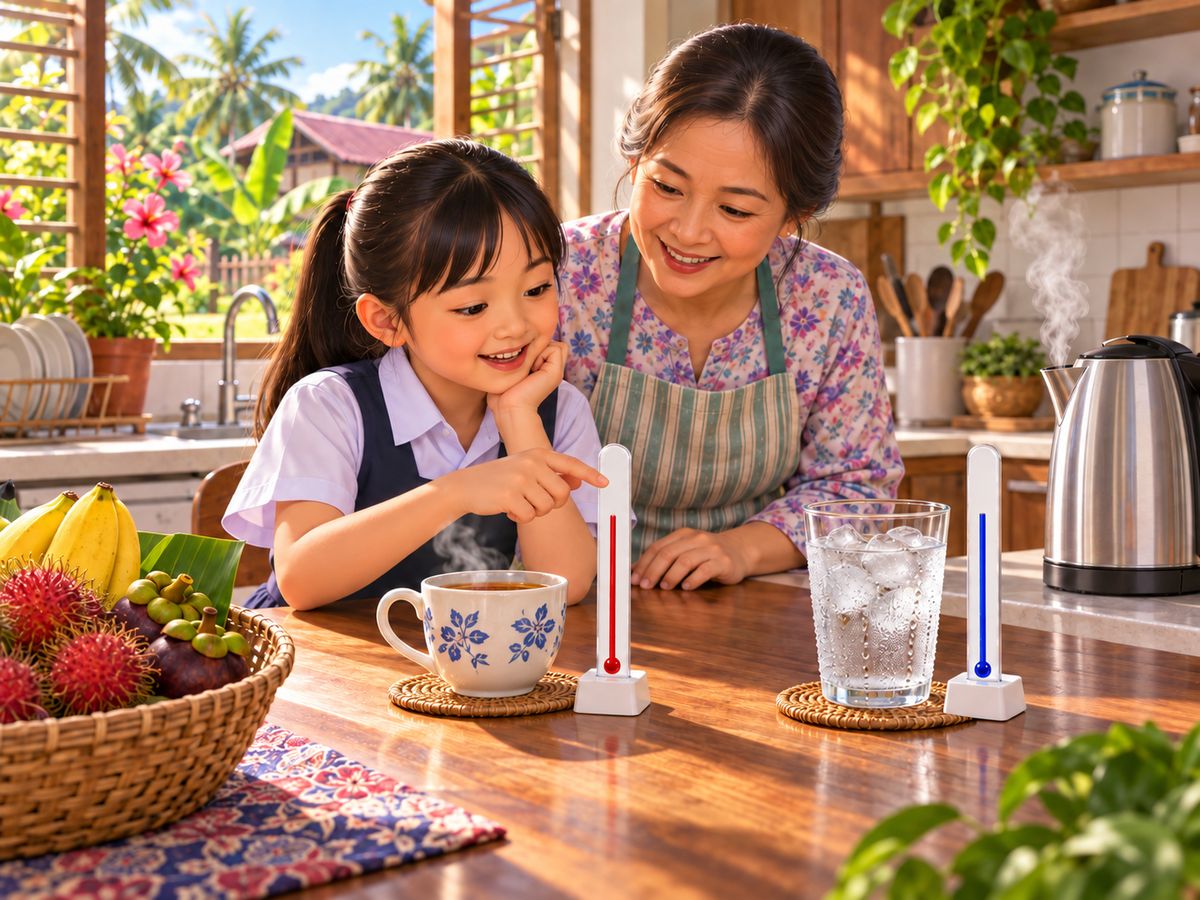
在食堂里,三个同学喝着不同的饮料,有人说“好热”,有人说“没那么热”。单凭手的触觉,我们只能分辨热和冷,却不能准确说出有多热。所以,人们用温度来表示物质的冷热程度。温度越高,物质越热。
suhu = 温度
Suhu ialah darjah kepanasan atau kesejukan sesuatu bahan. Deria sentuhan hanya boleh membezakan panas dan sejuk secara kasar. Kita tidak dapat mengetahui nilai yang tepat dengan menyentuh sahaja. Oleh itu, kita menggunakan suhu supaya bacaan lebih tepat.
Contoh: Dua cawan teh sama-sama terasa panas, tetapi termometer menunjukkan 70°C dan 55°C.
Awas: Jangan sentuh bahan yang terlalu panas atau terlalu sejuk kerana kulit boleh tercedera.
temperature = 温度
Temperature is the degree of hotness or coldness of a substance. Our sense of touch can only tell hot from cold roughly. Touching cannot give us an exact value. That is why we use temperature to describe how hot something really is.
Example: Two cups of tea both feel hot, but a thermometer shows 70°C and 55°C.
Watch out: Do not touch things that are too hot or too cold, because they can hurt your skin.
下面哪一句正确地说出“热”和“温度”的分别?
haba dan suhu = 热与温度
Bezakan dua istilah ini dengan teliti. Satu daripadanya ialah tenaga yang boleh memanaskan bahan. Satu lagi ialah darjah panas atau sejuk sesuatu bahan. Baca setiap pilihan dan semak sama ada kedua-dua istilah diterangkan dengan betul.
Contoh: Api dapur memberikan tenaga kepada air, lalu bacaan termometer air itu naik.
heat and temperature = 热与温度
Separate these two terms carefully. One of them is the energy that can warm a substance. The other is the degree of hotness or coldness of a substance. Read every option and check whether both terms are described correctly.
Example: A stove flame gives energy to water, and the thermometer reading of the water goes up.
实验室温度计与摄氏度
要准确地测量温度,我们使用实验室温度计。常用的温度测量单位是摄氏度,符号是 °C。实验室温度计里的液体一般是酒精或水银,所以有酒精温度计和水银温度计两种。开尔文(K)和华氏温度(°F)也是温度测量单位。
darjah Celsius = 摄氏度
Termometer makmal digunakan untuk mengukur suhu dengan tepat. Unit suhu yang biasa digunakan ialah darjah Celsius dengan simbol °C. Cecair di dalam termometer makmal biasanya alkohol atau merkuri. Kelvin dan Fahrenheit juga merupakan unit suhu.
Contoh: Ramalan cuaca menyatakan suhu tertinggi di Kota Kinabalu esok ialah 32°C.
Awas: Tulis unit °C selepas nombor, contohnya 32°C, bukan 32 sahaja.
degree Celsius = 摄氏度
A laboratory thermometer measures temperature accurately. The common unit of temperature is the degree Celsius, written as °C. The liquid inside a laboratory thermometer is usually alcohol or mercury. Kelvin and Fahrenheit are also units of temperature.
Example: The weather forecast says the highest temperature in Kota Kinabalu tomorrow will be 32°C.
Watch out: Always write the unit after the number, for example 32°C, not just 32.
温度计的构造
温度计的下端是玻璃泡,里面装着酒精或水银;液体会沿着细细的玻璃管上升或下降。玻璃管上有刻度,让我们读出温度;上端是捏手处。酒精温度计的酒精柱通常染成红色,水银温度计的水银柱是银灰色的。周围越热,液柱升得越高。
bebuli termometer = 玻璃泡
Bahagian bawah termometer ialah bebuli yang mengandungi alkohol atau merkuri. Cecair itu naik atau turun di dalam tiub kaca yang halus. Skala pada tiub kaca membolehkan kita membaca suhu, dan bahagian atas ialah tempat memegang. Turus cecair naik apabila persekitaran lebih panas.
Contoh: Turus alkohol berwarna merah naik perlahan-lahan apabila termometer dibawa dari bilik berhawa dingin ke bawah matahari.
Awas: Alkohol dan merkuri mengembang dengan ketara apabila dipanaskan, sebab itu ia sesuai digunakan.
thermometer bulb = 玻璃泡
The bottom of a thermometer is the bulb, which holds alcohol or mercury. The liquid rises or falls inside a thin glass tube. The scale on the tube lets us read the temperature, and the top end is where we hold it. The liquid column rises when the surroundings get warmer.
Example: The red alcohol column climbs slowly when a thermometer is carried from an air-conditioned room into the sun.
Watch out: Alcohol and mercury expand clearly when heated, which is why they are chosen.
正确地使用温度计
用温度计测量水温时:以直立的方式拿着温度计的捏手处;把温度计浸入水里,玻璃泡不能碰到烧杯底和烧杯壁;等酒精柱或水银柱停止移动后才读数;读数时,温度计不能离开水。玻璃泡碰到杯底,量到的可能是杯子的温度,不是水的温度。
langkah menggunakan termometer = 用温度计
Pegang termometer secara tegak pada bahagian pemegang. Masukkan bebuli ke dalam air tanpa menyentuh dasar atau dinding bikar. Tunggu sehingga turus cecair berhenti bergerak sebelum membaca. Biarkan termometer di dalam air semasa membuat bacaan.
Contoh: Jika bebuli menyentuh dasar bikar yang dipanaskan, bacaan menjadi lebih tinggi daripada suhu air sebenar.
Awas: Jangan angkat termometer keluar dari air untuk dibaca, kerana bacaan akan berubah.
using a thermometer = 用温度计
Hold the thermometer upright by its handle. Put the bulb into the water without touching the base or the side of the beaker. Wait until the liquid column stops moving before reading. Keep the thermometer in the water while taking the reading.
Example: If the bulb touches the bottom of a heated beaker, the reading will be higher than the real water temperature.
Watch out: Do not lift the thermometer out of the water to read it, because the reading will change.
读数:视线与弯月面平行
读取读数时,眼睛的视线要与酒精柱或水银柱的弯月面平行。眼睛太高或太低,读到的数都会不准确。水银是有毒的液体,使用水银温度计要特别小心;不小心打破了,要马上告诉老师,不可用手去碰。
meniskus = 弯月面
Semasa membaca termometer, aras mata mesti selari dengan meniskus turus alkohol atau merkuri. Jika mata terlalu tinggi atau terlalu rendah, bacaan yang diperoleh tidak tepat. Merkuri ialah cecair beracun, jadi termometer merkuri mesti dikendalikan dengan cermat.
Contoh: Mei Ling membongkok sehingga matanya separas dengan hujung turus cecair, lalu membaca 38°C.
Awas: Jika termometer merkuri pecah, beritahu guru dengan segera.
meniscus = 弯月面
When reading a thermometer, your eye level must be in line with the meniscus of the alcohol or mercury column. If your eyes are too high or too low, the reading you get will not be accurate. Mercury is poisonous, so handle a mercury thermometer with great care.
Example: Mei Ling bends down until her eyes are level with the top of the liquid column, then reads 38°C.
Watch out: If a mercury thermometer breaks, tell your teacher at once.
测量一杯热水的温度时,以下哪一个做法是正确的?
cara membaca termometer = 读温度计
Fikirkan langkah yang memberikan bacaan paling tepat bagi suhu air. Bacaan berubah jika termometer diangkat keluar atau jika bebuli menyentuh bikar. Bacaan juga belum tepat jika turus cecair masih bergerak. Pilih langkah yang dibuat dengan cara yang betul.
Contoh: Jika mata tidak separas dengan meniskus, bacaan 40°C mungkin tersilap dibaca sebagai nilai lain.
reading a thermometer = 读温度计
Think about which step gives the most accurate reading of the water temperature. The reading changes if the thermometer is lifted out or if the bulb touches the beaker. The reading is also not ready while the liquid column is still moving. Choose the step that is done the right way.
Example: If your eyes are not level with the meniscus, a 40°C reading may be misread as another value.
冰点和沸点
水开始变成冰块时的温度叫做冰点;水开始变成水蒸气时的温度叫做沸点。我们可以把一杯冰块放在本生灯上慢慢加热,每隔 2 分钟测量一次温度,把资料整理成线形图,就能找出水的冰点和沸点。加热时火势不能太大,以免烧杯破裂。
takat beku dan takat didih = 冰点和沸点
Takat beku ialah suhu apabila air mula bertukar menjadi ais. Takat didih ialah suhu apabila air mula bertukar menjadi wap air. Kita boleh memanaskan ais dengan penunu Bunsen dan mencatat suhu setiap dua minit. Data itu dipindahkan ke dalam graf garis untuk mencari kedua-dua takat.
Contoh: Air di dalam bekas ais membeku di dalam peti sejuk beku, manakala air di dalam cerek mendidih di atas dapur.
Awas: Nyalaan penunu Bunsen tidak boleh terlalu besar supaya bikar tidak retak.
freezing point and boiling point = 冰点和沸点
The freezing point is the temperature at which water starts to turn into ice. The boiling point is the temperature at which water starts to turn into steam. We can heat ice with a Bunsen burner and record its temperature every two minutes. The data is then drawn as a line graph to find both points.
Example: Water in an ice tray freezes in the freezer, while water in a kettle boils on the stove.
Watch out: Keep the Bunsen burner flame small so that the beaker does not crack.
水的冰点是 0°C,沸点是 100°C
从线形图看:冰块刚开始加热时,温度停在 0°C 一段时间,这时冰正在变成水;接着温度一直上升;到了 100°C,水沸腾了,即使继续加热,温度也保持不变。所以水的冰点是 0°C,沸点是 100°C。不同的液体有不同的沸点。
graf garis = 线形图
Graf garis menunjukkan perubahan suhu mengikut masa. Pada awalnya suhu ais kekal pada 0°C buat seketika. Kemudian suhu air naik sehingga mencapai 100°C. Selepas air mendidih, suhunya kekal walaupun pemanasan diteruskan.
Contoh: Bacaan setiap dua minit ialah 0, 0, 22, 48, 75, 100 dan 100 darjah Celsius.
Awas: Cecair lain mempunyai takat didih yang berbeza daripada air.
line graph = 线形图
A line graph shows how temperature changes over time. At the start, the temperature of the ice stays at 0°C for a while. Then the water warms up until it reaches 100°C. After the water boils, its temperature stays the same even though heating continues.
Example: Readings taken every two minutes are 0, 0, 22, 48, 75, 100 and 100 degrees Celsius.
Watch out: Other liquids have boiling points that are different from water.
一壶水已经沸腾了,妈妈继续加热 5 分钟。这时水的温度会怎样?
suhu air mendidih = 沸水的温度
Imbas kembali graf pemanasan ais hingga mendidih. Garis graf naik sehingga satu nilai tertentu, kemudian menjadi mendatar. Bahagian mendatar bermaksud suhu tidak berubah lagi walaupun api masih menyala. Pilih jawapan yang sepadan dengan bahagian itu.
Contoh: Cerek yang terus dipanaskan selepas mendidih hanya menghasilkan lebih banyak wap.
temperature of boiling water = 沸水的温度
Recall the graph for heating ice until it boils. The line rises to a certain value and then becomes flat. The flat part means the temperature no longer changes even though the flame is still on. Pick the answer that matches that flat part.
Example: A kettle kept on the flame after boiling only produces more steam.
热水会降温到室温
把一杯热水搁置在室内,每隔 2 分钟测量一次,会发现水温逐渐下降,下降到室温后就保持不变。室温是指室内的温度,一般大约是 25°C 至 27°C。热水的热会传到周围较冷的空气中,直到水和空气一样温度为止。
suhu bilik = 室温
Air panas yang dibiarkan di dalam bilik akan menyejuk sedikit demi sedikit. Haba daripada air mengalir ke udara sekeliling yang lebih sejuk. Suhu air terus turun sehingga sama dengan suhu bilik, lalu kekal. Suhu bilik biasanya sekitar 25°C hingga 27°C.
Contoh: Secawan Milo 80°C yang terlupa diminum menjadi 26°C selepas tiga jam.
Awas: Air panas tidak akan menjadi lebih sejuk daripada suhu bilik jika dibiarkan begitu sahaja.
room temperature = 室温
Hot water left in a room cools down little by little. Heat flows from the water to the cooler air around it. The water temperature keeps dropping until it matches the room temperature, then it stays there. Room temperature is usually about 25°C to 27°C.
Example: A cup of 80°C Milo that was forgotten becomes 26°C after three hours.
Watch out: Hot water left alone will not become colder than the room.
房间的温度是 27°C。一杯 90°C 的热水放在房里两个小时后,温度最可能是多少?
air panas menyejuk = 热水降温
Fikirkan ke mana haba air panas itu pergi semasa dibiarkan. Air itu kehilangan haba kepada udara bilik sehingga suhunya sama. Suhu tidak akan jatuh lebih rendah daripada suhu udara di sekelilingnya. Bandingkan setiap pilihan dengan suhu bilik yang diberikan.
Contoh: Sup yang dihidangkan panas akhirnya menjadi sesejuk bilik makan jika tidak dimakan.
hot water cooling = 热水降温
Think about where the heat of the hot water goes while it is left alone. The water loses heat to the room air until both are equally warm. The temperature will not fall below the temperature of the air around it. Compare each option with the room temperature given.
Example: Soup served hot finally becomes as cool as the dining room if nobody eats it.
受热变热,散热变冷
打完篮球,放在太阳下的水瓶变得热热的;放在树荫下一会儿,它又散热变凉。把塑料、铁和木制成的汤匙浸在热水里,拿出来都变热了;再浸到冷水里,又都变冷了。把加热过的铁球放进一杯水里,水温上升;放进冰块,水温下降。
menerima haba dan membebaskan haba = 受热和散热
Bahan yang menerima haba menjadi lebih panas dan suhunya naik. Bahan yang membebaskan haba menjadi lebih sejuk dan suhunya turun. Sudu plastik, besi dan kayu yang direndam dalam air panas semuanya menjadi panas. Apabila direndam dalam air sejuk, semuanya menjadi sejuk semula.
Contoh: Bola besi yang dipanaskan menaikkan suhu air, manakala ketulan ais menurunkan suhu air.
Awas: Air panas untuk aktiviti ini tidak boleh terlalu panas supaya tangan tidak melecur.
gaining and losing heat = 受热和散热
A substance that gains heat becomes hotter and its temperature rises. A substance that loses heat becomes colder and its temperature falls. Plastic, iron and wooden spoons soaked in hot water all become hot. When soaked in cold water, they all turn cold again.
Example: A heated iron ball raises the water temperature, while ice cubes lower it.
Watch out: The hot water for this activity must not be too hot, so that hands are not scalded.
固体受热膨胀,散热收缩
一个铁球刚好能穿过铁环。用本生灯加热铁球 2 分钟后,铁球变大了,卡在铁环上穿不过去,这叫膨胀。把铁球放进冷水 2 分钟,铁球变小了,又能穿过铁环,这叫收缩。做这个实验时,只加热铁球,不要同时加热铁环。
mengembang dan mengecut = 膨胀和收缩
Pepejal seperti bola besi menjadi lebih besar apabila dipanaskan, iaitu mengembang. Apabila disejukkan, bola besi menjadi lebih kecil, iaitu mengecut. Bola yang mengembang tidak dapat melalui gelang besi. Selepas disejukkan dalam air, bola itu dapat melaluinya semula.
Contoh: Pintu pagar besi lebih sukar ditutup pada tengah hari yang panas berbanding pada waktu petang.
Awas: Panaskan bola besi sahaja, bukan gelang besi, supaya keputusan tidak terjejas.
expand and contract = 膨胀和收缩
A solid such as an iron ball becomes bigger when heated, which is called expanding. When cooled, the iron ball becomes smaller, which is called contracting. The expanded ball cannot pass through the iron ring. After being cooled in water, it can pass through again.
Example: An iron gate is harder to close on a hot afternoon than in the cool evening.
Watch out: Heat only the ball, not the ring, so that the result is fair.
液体和气体也会热胀冷缩
锥形瓶装满颜色水,插上玻璃管。把瓶子浸入热水,玻璃管里的水位上升;再浸入冷水,水位下降。用颜色水是为了看清楚水位的变化。把气球套在玻璃瓶口,放进热水盆,气球慢慢鼓起来;放进冷水,气球又瘪下去。
cecair dan gas = 液体和气体
Cecair juga mengembang apabila dipanaskan dan mengecut apabila disejukkan. Aras air berwarna dalam tiub kaca naik di dalam air panas dan turun di dalam air sejuk. Udara di dalam botol mengembang lalu meniup belon apabila botol diletakkan dalam air panas. Dalam air sejuk, udara mengecut dan belon menjadi kempis.
Contoh: Bungkusan kerepek di dalam kereta yang panas menjadi kembung.
Awas: Air berwarna digunakan supaya perubahan aras lebih mudah dilihat.
liquids and gases = 液体和气体
Liquids also expand when heated and contract when cooled. The level of coloured water in a glass tube rises in hot water and falls in cold water. Air in a bottle expands and inflates a balloon when the bottle is placed in hot water. In cold water, the air contracts and the balloon goes flat.
Example: A sealed packet of chips left in a hot car becomes puffy.
Watch out: Coloured water is used so that the change in level is easier to see.
热胀冷缩
物质受热后会变得较热、温度上升和膨胀;散热后会变得较冷、温度下降和收缩。固体、液体和气体都有这个性质,叫做热胀冷缩。这是因为物质里都有粒子,受热时粒子振动得更厉害。特别注意:水散热后会收缩,但到达冰点后会膨胀成冰块,这是一种特殊的膨胀现象。
pengembangan dan pengecutan = 热胀冷缩
Bahan yang dipanaskan menjadi panas, suhunya naik dan bahan itu mengembang. Bahan yang disejukkan menjadi sejuk, suhunya turun dan bahan itu mengecut. Pepejal, cecair dan gas semuanya menunjukkan sifat ini kerana zarahnya bergetar lebih kuat apabila dipanaskan. Air ialah kes istimewa kerana ia mengembang apabila membeku menjadi ais.
Contoh: Botol plastik penuh air yang dimasukkan ke dalam peti sejuk beku menjadi menggelembung selepas air membeku.
Awas: Jangan tersalah: air yang membeku mengembang, bukan mengecut.
expansion and contraction = 热胀冷缩
A heated substance becomes hotter, its temperature rises and it expands. A cooled substance becomes colder, its temperature falls and it contracts. Solids, liquids and gases all show this property because their particles vibrate more strongly when heated. Water is a special case because it expands when it freezes into ice.
Example: A plastic bottle filled with water bulges in the freezer after the water turns to ice.
Watch out: Do not mix this up: freezing water expands, it does not contract.
温度计和热胀冷缩实验台
先把温度计放进四种水里,看液柱升降并读出温度;再换到“铁球和铁环”,把铁球加热、放进冷水,看它能不能穿过铁环。
termometer = 温度计
Cecair dalam termometer mengembang apabila menerima haba, jadi turus cecair naik. Apabila cecair membebaskan haba, ia mengecut dan turus turun. Baca nombor pada skala di hujung turus cecair. Bola besi pula membesar selepas dipanaskan sehingga tersangkut pada gelang besi, kemudian mengecil semula di dalam air sejuk.
Contoh: Dalam air yang sedang mendidih, turus berhenti pada 100 darjah Celsius walaupun api masih menyala.
thermometer = 温度计
The liquid inside the thermometer expands when it gains heat, so the column rises. When the liquid loses heat it contracts and the column falls. Read the number on the scale at the top of the column. The iron ball also grows after heating until it gets stuck on the ring, then shrinks again in cold water.
Example: In boiling water the column stops at 100 degrees Celsius even though the flame is still burning.
在实验台上,加热过的铁球为什么穿不过铁环?
mengembang = 膨胀
Fikirkan apa yang dipanaskan dalam eksperimen itu, iaitu bola atau gelang. Kemudian fikirkan bagaimana saiz bahan yang menerima haba berubah. Jisim bola tidak bertambah apabila dipanaskan. Hanya saiznya yang berubah, dan saiz itulah yang menentukan sama ada bola boleh melalui gelang.
Contoh: Pintu besi lebih sukar ditutup pada tengah hari yang panas berbanding pada waktu petang yang sejuk.
expand = 膨胀
Think about which object was heated in the experiment, the ball or the ring. Then think about how the size of an object changes when it gains heat. The mass of the ball does not increase when it is heated. Only its size changes, and that size decides whether the ball can pass through the ring.
Example: An iron gate is harder to close at a hot noon than in the cool evening.
温度计放进沸腾的水里,液柱升到 100 °C 就不再上升。100 °C 是水的什么?
takat didih = 沸点
Ingat dua suhu penting bagi air yang dipelajari dalam unit ini. Satu ialah suhu ketika air mula berubah menjadi ais. Satu lagi ialah suhu ketika air mula berubah menjadi wap dengan banyak gelembung besar. Selepas suhu itu dicapai, suhu air tidak naik lagi walaupun terus dipanaskan.
Contoh: Semasa memasak air untuk membancuh teh, gelembung besar muncul dan wap keluar dari cerek.
boiling point = 沸点
Remember the two important temperatures of water learnt in this unit. One is the temperature at which water starts to turn into ice. The other is the temperature at which water starts to turn into steam with many big bubbles. After that temperature is reached, the water does not get any hotter even with more heating.
Example: When water is heated for tea, big bubbles appear and steam comes out of the kettle.
把一个套着气球的空玻璃瓶放进热水盆里,气球鼓起来。这是因为什么?
udara mengembang = 空气膨胀
Botol itu kosong, jadi cuma ada udara di dalamnya. Fikirkan apa yang berlaku kepada gas apabila ia menerima haba daripada air panas. Gas yang berubah saiz akan menolak belon. Tolak pilihan yang menyebut pengecutan atau air yang masuk ke dalam botol.
Contoh: Belon yang ditinggalkan di dalam kereta panas boleh meletup.
air expanding = 空气膨胀
The bottle is empty, so only air is inside it. Think about what happens to a gas when it gains heat from the hot water. A gas that changes size will push on the balloon. Rule out the options that talk about shrinking or water entering the bottle.
Example: A balloon left inside a hot car may burst.
温度计和消防喷头
生活中有些用具就是应用热胀冷缩原理来运作的,例如温度计和消防喷头。温度计里的液体受热膨胀,液柱上升;遇冷收缩,液柱下降,所以能显示温度。消防喷头里的小玻璃管装着液体,火灾时液体受热膨胀,把玻璃管撑破,水就喷出来。
pemercik api = 消防喷头
Sesetengah alat berfungsi berdasarkan prinsip pengembangan dan pengecutan. Cecair dalam termometer naik apabila panas dan turun apabila sejuk. Pemercik api mempunyai tiub kaca kecil berisi cecair yang mengembang apabila suhu sangat tinggi. Tiub itu pecah lalu air disembur keluar.
Contoh: Pemercik api di siling pusat membeli-belah hanya menyembur air apabila berlaku kebakaran berhampiran.
fire sprinkler = 消防喷头
Some tools work using the principle of expansion and contraction. The liquid in a thermometer rises when warm and falls when cool. A fire sprinkler has a small glass tube of liquid that expands when the temperature becomes very high. The tube breaks and water sprays out.
Example: Sprinklers on a shopping mall ceiling only spray water when there is a fire nearby.
电线、铁轨和高架桥
人们应用热胀冷缩原理来建造各种设施。电线松弛地挂在电杆上,是为了防止电线在天气冷时收缩而扯断。火车铁轨之间留有空隙,是为了避免铁轨在天气热时膨胀而变形。高架桥梁和桥面也留有空隙(伸缩缝),是为了避免热天时膨胀而裂开。
landasan dan jambatan = 铁轨和桥梁
Wayar elektrik digantung secara kendur supaya tidak putus apabila mengecut pada cuaca sejuk. Ruang kecil ditinggalkan di antara landasan kereta api supaya landasan tidak bengkok apabila mengembang pada hari panas. Jambatan dan jalan bertingkat juga mempunyai ruang supaya tidak retak. Semua reka bentuk ini memberi tempat kepada bahan untuk berubah saiz.
Contoh: Tanpa ruang, landasan yang mengembang akan saling menolak dan menjadi bengkok.
Awas: Wayar kendur untuk cuaca sejuk; ruang landasan dan jambatan untuk cuaca panas.
rails and bridges = 铁轨和桥梁
Electric wires hang loosely so that they do not snap when they contract in cold weather. Small gaps are left between railway tracks so that the tracks do not bend when they expand on hot days. Bridges and flyovers also have gaps so that they do not crack. All these designs give materials room to change size.
Example: Without gaps, expanding rails push against each other and bend.
Watch out: Loose wires are for cold weather; gaps in rails and bridges are for hot weather.
火车铁轨之间为什么要留有空隙?
ruang landasan = 铁轨空隙
Landasan kereta api diperbuat daripada logam yang berubah saiz mengikut suhu. Tanya diri sendiri bilakah landasan memerlukan ruang tambahan. Ruang itu diperlukan apabila logam menjadi lebih panjang. Padankan sebab ini dengan jenis cuaca yang betul.
Contoh: Jubin lantai di luar rumah juga diberi ruang kecil atas sebab yang sama.
gaps in railway tracks = 铁轨空隙
Railway tracks are made of metal that changes size with temperature. Ask yourself when the tracks need extra room. The room is needed when the metal becomes longer. Match this reason with the correct kind of weather.
Example: Outdoor floor tiles are also given small gaps for the same reason.
用热胀冷缩解决生活难题
把凹陷的乒乓球放进热水,球里的空气受热膨胀,乒乓球就恢复原状。瓶盖拧不开时,把瓶盖浸一浸热水,瓶盖受热膨胀,就容易拧开了。两个玻璃杯紧紧套在一起时,在上面的杯子加冰块,它遇冷收缩,两个杯子就能分开。
menyelesaikan masalah harian = 解决难题
Prinsip pengembangan dan pengecutan boleh membantu kita dalam kehidupan seharian. Bola pingpong yang kemik direndam dalam air panas supaya udara di dalamnya mengembang. Penutup botol yang ketat direndam dalam air panas supaya penutup itu mengembang. Gelas yang tersangkut boleh dipisahkan dengan meletakkan ais dalam gelas atas supaya gelas itu mengecut.
Contoh: Ibu merendam penutup balang jem dalam air suam, kemudian penutup itu mudah dibuka.
Awas: Panaskan bahagian luar yang perlu menjadi lebih besar, sejukkan bahagian dalam yang perlu menjadi lebih kecil.
solving daily problems = 解决难题
The principle of expansion and contraction can help us in daily life. A dented ping-pong ball is soaked in hot water so that the air inside expands. A tight bottle cap is dipped in hot water so that the cap expands. Two stuck glasses can be separated by putting ice in the top glass so that it contracts.
Example: Mum dips a tight jam-jar lid in warm water, and then it opens easily.
Watch out: Warm the outer part that needs to get bigger, and cool the inner part that needs to get smaller.
动动脑:更多的应用
水喉管紧紧套在水龙头上拔不下来,可以用热水淋一淋水喉管的接口,让它受热膨胀,就容易拔下。人行道的地砖之间也留有空隙,是为了避免地砖在大太阳下膨胀而互相挤压裂开。我们还可以应用热胀冷缩,动手设计一个简单的火警警报器。
aplikasi lain = 更多的应用
Hos getah yang ketat pada paip boleh dicurah air panas supaya hujungnya mengembang dan mudah ditanggalkan. Jubin laluan pejalan kaki dipasang dengan ruang kecil supaya tidak retak apabila mengembang di bawah matahari. Lantai simen yang luas juga perlu dibahagi dengan ruang. Prinsip ini juga boleh digunakan untuk mereka penggera kebakaran ringkas.
Contoh: Lantai simen di halaman yang tiada ruang boleh retak selepas lama terdedah kepada matahari.
more applications = 更多的应用
Hot water poured on a tight garden hose makes its end expand, so it can be pulled off the tap easily. Paving tiles on a walkway are laid with small gaps so that they do not crack when they expand in the sun. A large cement floor also needs to be divided by gaps. This principle can even be used to design a simple fire alarm.
Example: A cement yard with no gaps may crack after a long time in the sun.
两个玻璃杯紧紧地套在一起。以下哪一个方法最能把它们分开?
memisahkan gelas = 分开玻璃杯
Gelas di bahagian dalam perlu menjadi lebih kecil. Gelas di bahagian luar pula perlu menjadi lebih besar. Fikirkan sama ada setiap gelas perlu dipanaskan atau disejukkan untuk mencapai tujuan itu. Jika kedua-dua gelas diberi suhu yang sama, kedudukannya tidak banyak berubah.
Contoh: Cincin yang ketat pada jari lebih mudah ditanggalkan selepas tangan direndam dalam air sejuk.
separating glasses = 分开玻璃杯
The inner glass needs to become smaller. The outer glass needs to become bigger. Decide whether each glass should be heated or cooled to make that happen. If both glasses get the same temperature, the fit hardly changes.
Example: A tight ring is easier to remove after the hand is soaked in cold water.
热:学完了!
本课学习了:热与温度、热对物质的影响、热胀冷缩在生活中的重要性。接下来做加强练习,巩固所学的科学知识吧!
开始加强练习 →rumusan haba = 热的总结
Haba ialah tenaga yang menjadikan bahan panas, manakala suhu ialah darjah kepanasan atau kesejukan bahan. Suhu diukur dengan termometer makmal dalam unit darjah Celsius. Takat beku air ialah 0°C, takat didih air ialah 100°C, dan air panas menyejuk hingga suhu bilik. Bahan mengembang apabila menerima haba dan mengecut apabila membebaskan haba.
Contoh: Wayar kendur, ruang landasan dan ruang jambatan ialah contoh penggunaan prinsip ini.
summary of heat = 热的总结
Heat is the energy that makes a substance hot, while temperature is how hot or cold a substance is. Temperature is measured with a laboratory thermometer in degrees Celsius. Water freezes at 0°C, boils at 100°C, and hot water cools down to room temperature. Substances expand when they gain heat and contract when they lose heat.
Example: Loose wires, gaps in railway tracks and gaps in bridges are examples of using this principle.